
Last updated August 25, 2026
Free on-site gate assessment - hinges, posts, and your LiftMaster or Nice gate operator checked before anything is quoted
The assessment is free and the quote is the invoice.
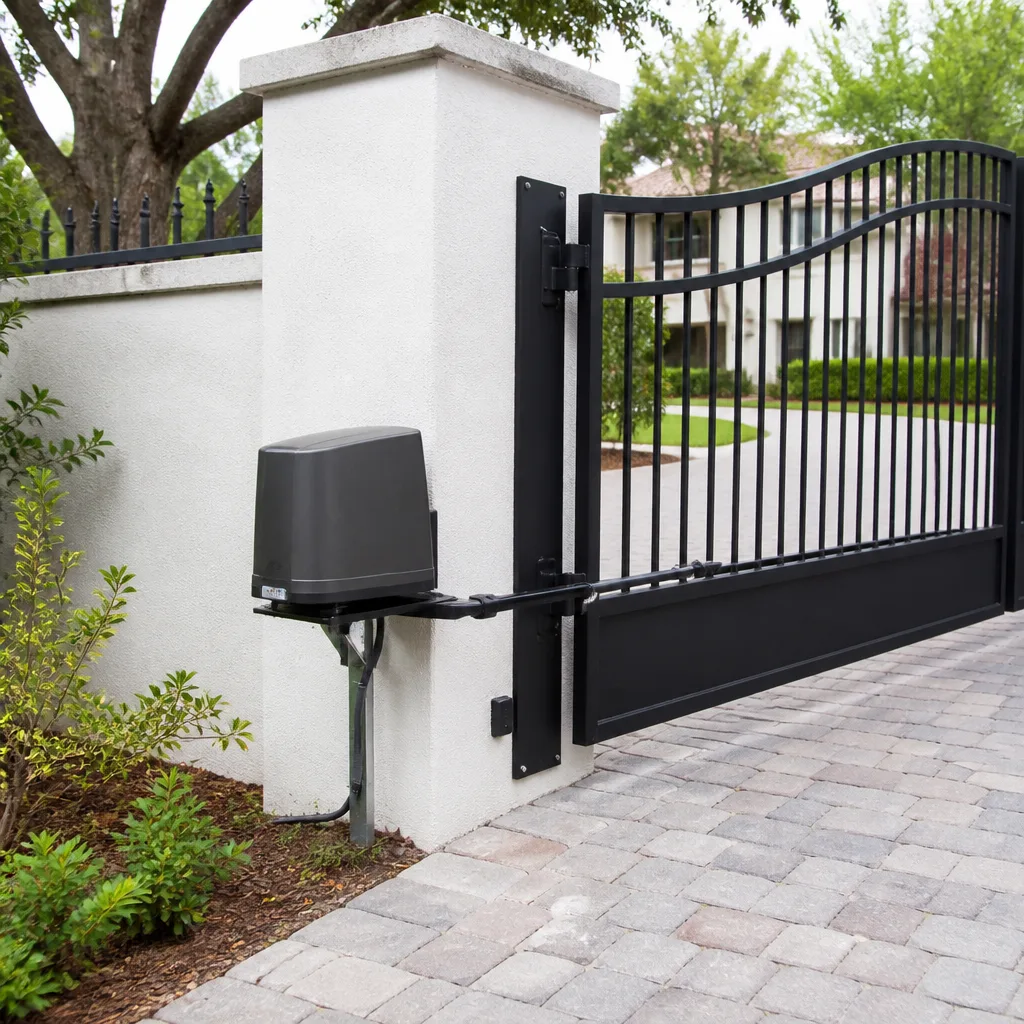
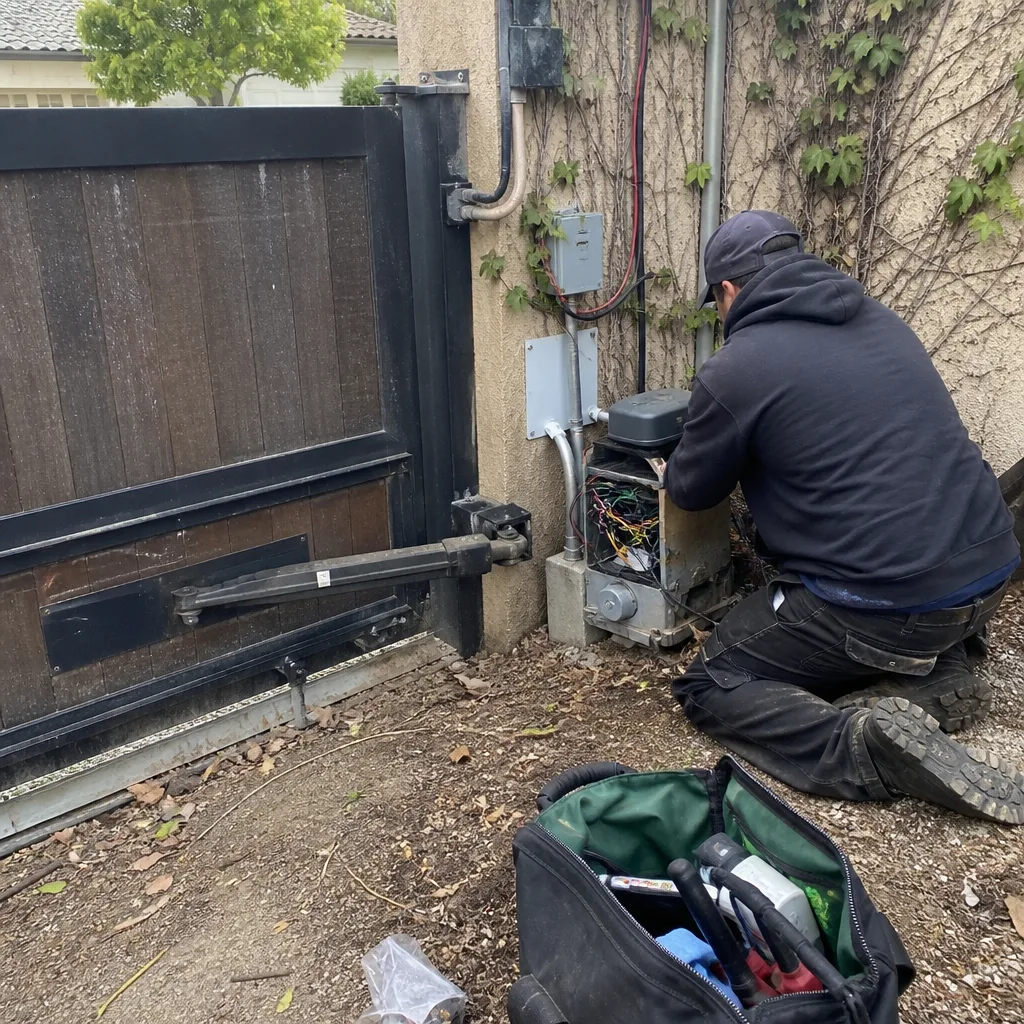 Before
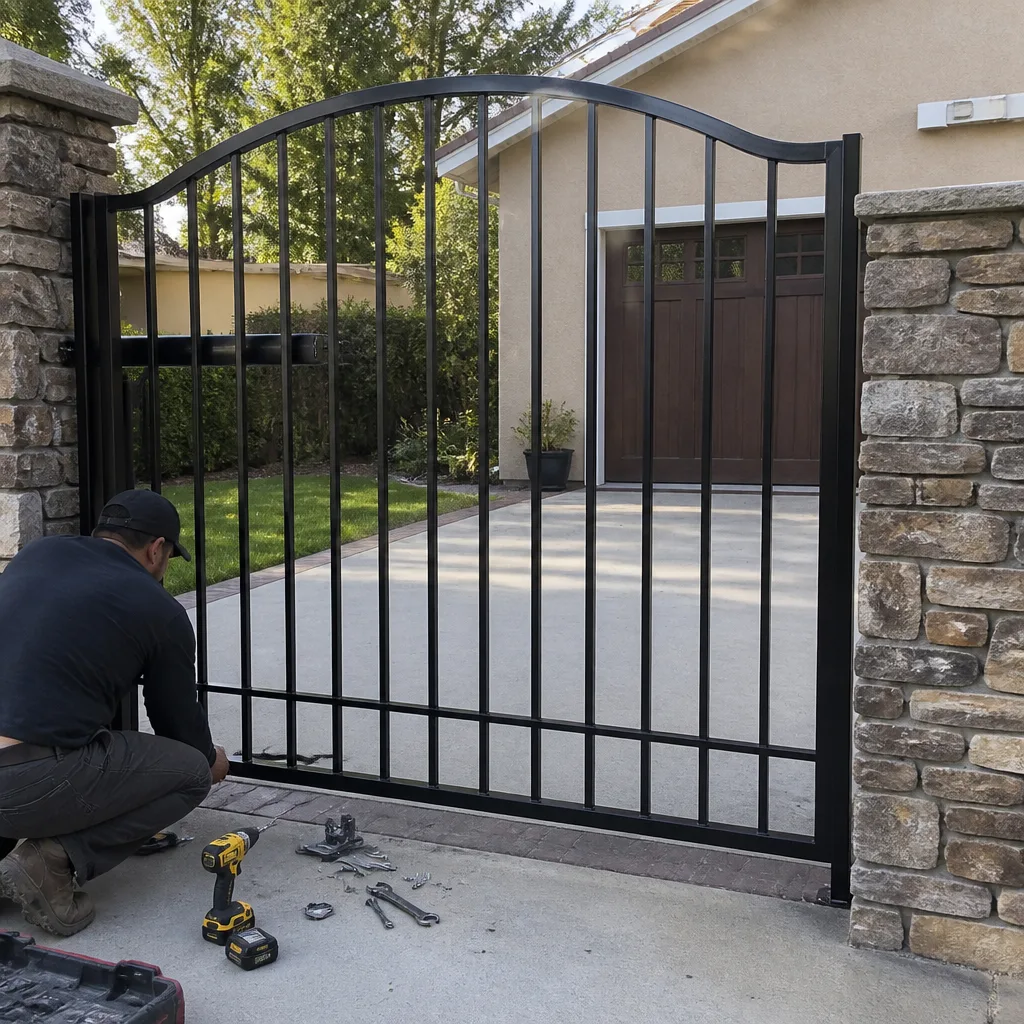 After
After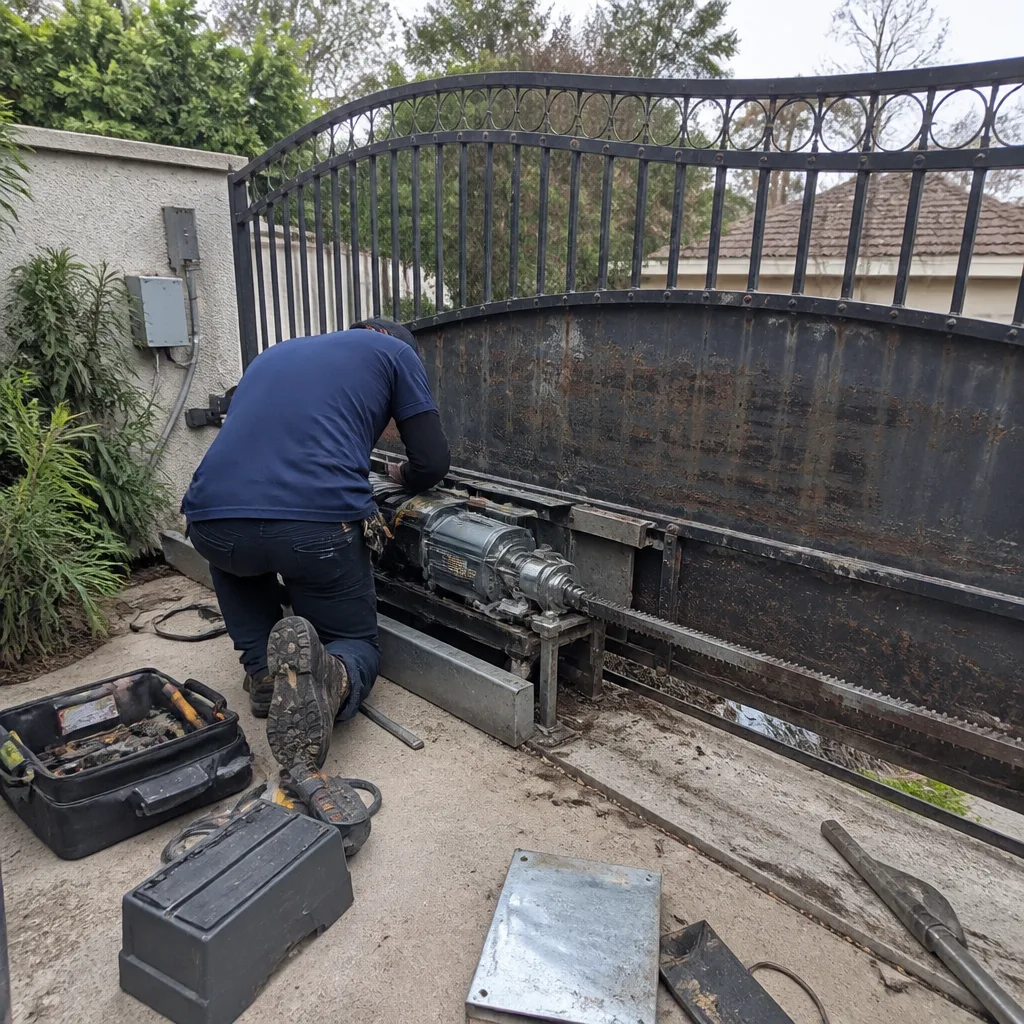 Before
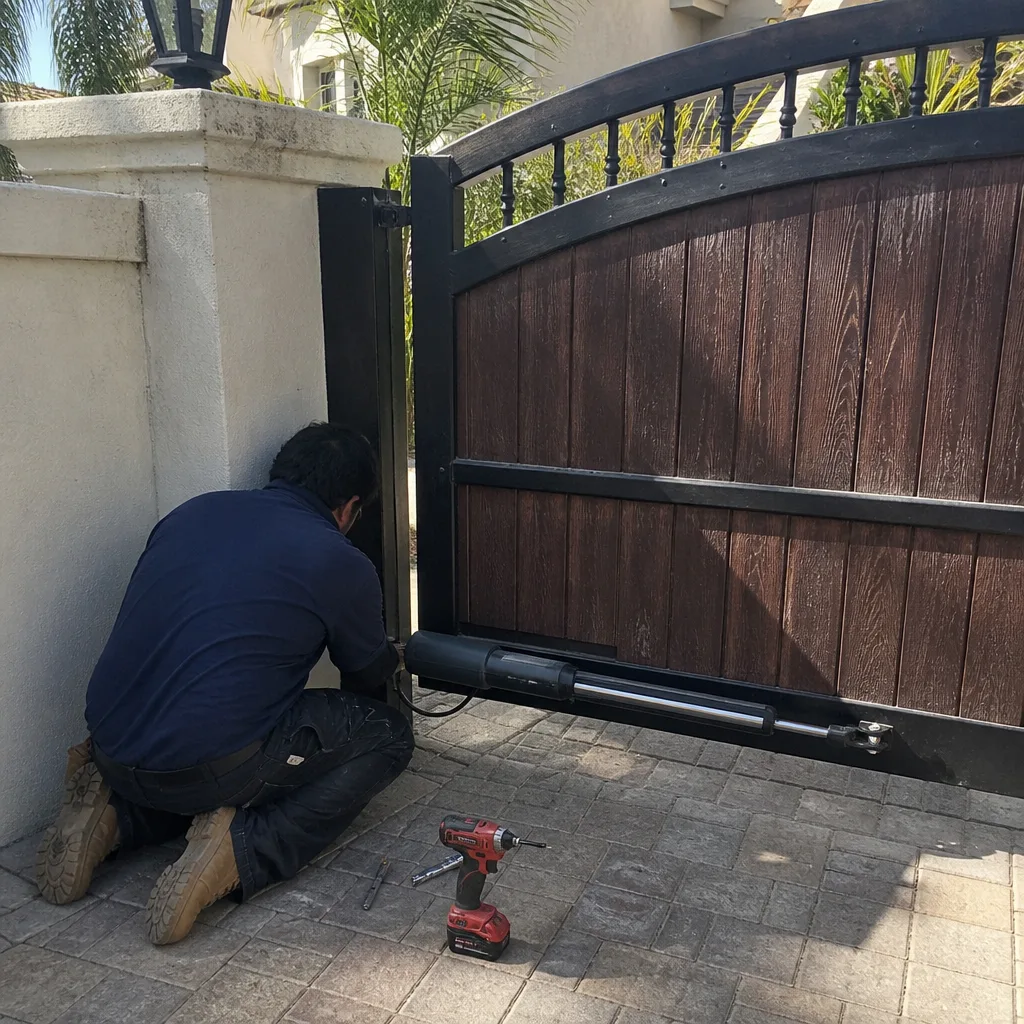 After
After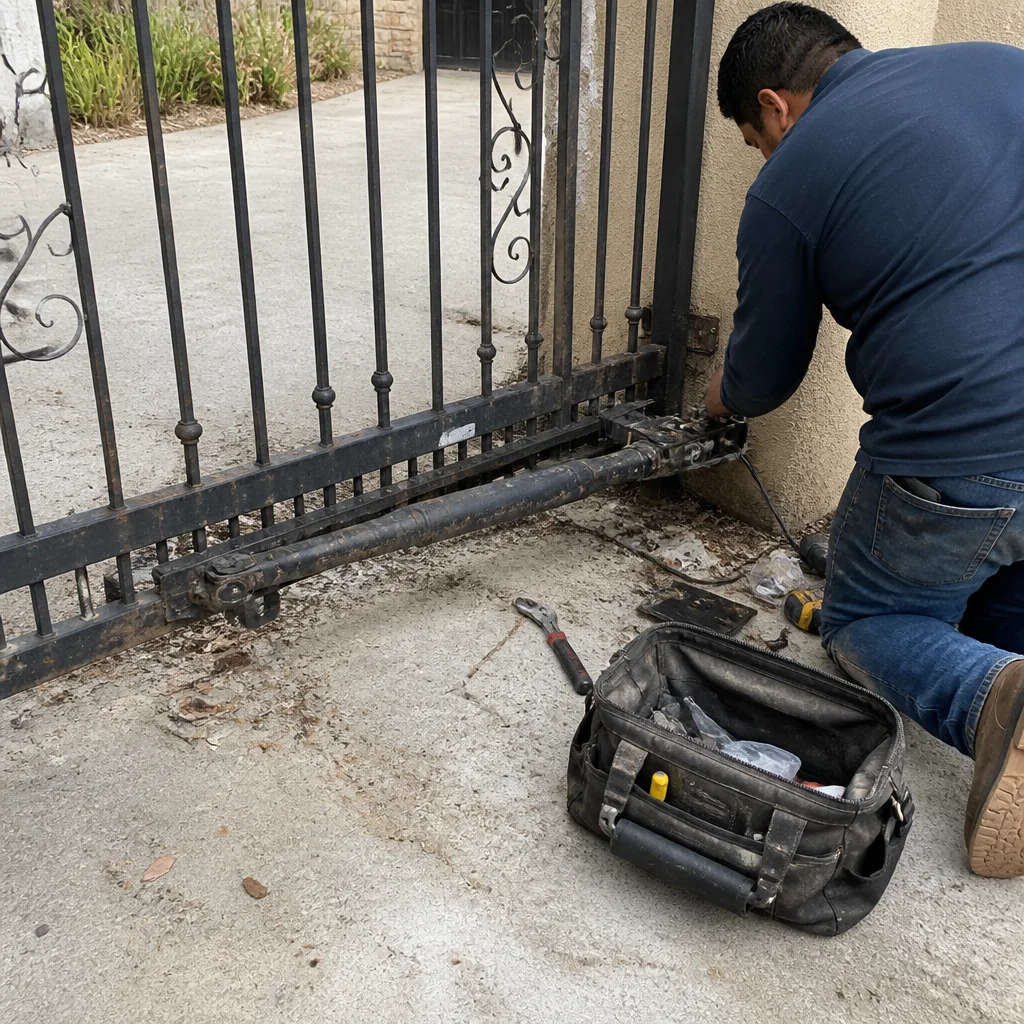 Before
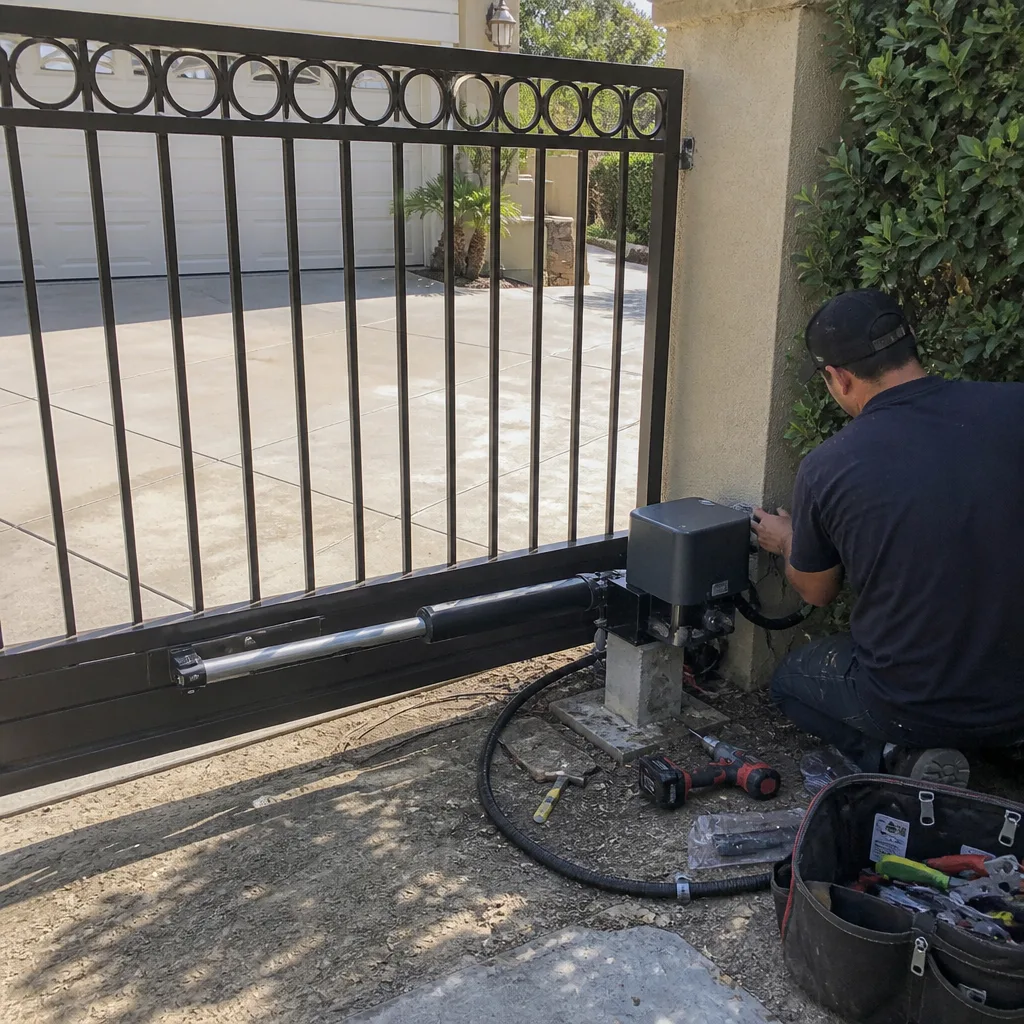 After
AfterGate Repair Warning Signs: A Agoura Hills Homeowner’s Reference Guide
Most driveway gates don’t fail suddenly. They fail in slow motion, giving off warnings for weeks or months before the day they finally refuse to open. The problem is that those warnings are easy to ignore until you’re parked at the curb, running late, staring at a gate that won’t budge. In Agoura Hills, where many properties sit on sloped lots and gates carry extra weight on the uphill side, we see the same pattern repeat itself every year: a homeowner notices a slight sag, a new noise, a slower cycle, and files it away as “I’ll deal with it later.” This guide will teach you to read those early signals before they become a 7 a.m. emergency call.
Quick Answer
The earliest warning signs of gate trouble are a change in how the gate sounds, a visible sag or lean, a slower-than-normal open and close cycle, and the opener motor struggling or reversing unexpectedly. Any one of these is a signal that a hinge, wheel, chain, or circuit board is wearing toward failure. Catching them early in Agoura Hills typically means a repair that takes an hour or two instead of a full gate replacement that can run several thousand dollars.
Table of Contents
- Warning Sign 1: The Gate Sounds Different
- Warning Sign 2: Visible Sag, Lean, or Drag
- Warning Sign 3: Slower Open and Close Cycles
- Warning Sign 4: The Motor Strains, Reverses, or Stops Partway
- Warning Sign 5: Remote and Keypad Inconsistency
- Warning Sign 6: Rust, Cracks, and Hardware Wear
- What Gate Repairs Cost in Agoura Hills
- Common Mistakes to Avoid
- When to Call a Professional
- Frequently Asked Questions
- The Bottom Line
Warning Sign 1: The Gate Sounds Different
Every gate has a baseline sound, a rhythm you’ve heard thousands of times. When that rhythm changes, the gate is telling you something. In our experience across Agoura Hills, this is the warning sign homeowners dismiss most often because it develops gradually. A gate that used to hum now groans. A gate that whispered now scrapes. A gate that clicked once now rattles through the whole cycle. None of these are normal aging. They are mechanical distress signals.
Here is what specific sounds usually mean:
- A grinding or scraping sound during movement almost always points to a wheel or roller dragging instead of rolling, or a gate that has shifted on its hinges and is now dragging against the ground, a post, or its own track.
- A high-pitched squeal is typically a bearing crying for lubrication or a belt slipping on a pulley. Left alone, the part overheats and fails.
- A metallic clunk or bang at the end of the travel means the gate is hitting its stop harder than it should. The limit switch on the opener may be out of adjustment, or a structural component has loosened.
- A louder-than-usual motor hum with slower movement suggests the opener is working harder than it was designed to. In Agoura Hills, where gates on slopes have to fight gravity, this is especially common on the uphill swing.
The practical rule is simple: if the sound changed, something changed. A gate that is properly hung, balanced, and adjusted should sound the same in year five as it did in year one. When a customer describes a sound to us over the phone, we can usually narrow the issue down before the truck rolls. The sound is a diagnostic tool, and it’s free to listen.
Warning Sign 2: Visible Sag, Lean, or Drag
Walk out to your gate and look at it from the street. Does it sit level, or does one corner hang lower than the other? Does the gap between the gate leaf and the driveway stay consistent, or does it shrink toward one end? A gate that sags is a gate whose hinge points are wearing, whose post is shifting, or whose welds are beginning to fatigue. This is structural, and structure does not fix itself.
In Agoura Hills, we contend with expansive clay soil in several neighborhoods. When the ground swells after winter rains and contracts through the dry summer, gate posts that were set without proper footings can move. Even a quarter-inch of post movement translates to visible sag at the far edge of a twelve-foot gate. That sag then compounds: the gate drags, the opener strains, the hinges wear faster, and the damage accelerates.
Here is a simple check you can do in about two minutes:
- Stand back and sight the top rail of the gate against the horizon or a known level line.
- Open the gate halfway and let go. A healthy gate on level ground should hold its position. If it drifts open or closed on its own, the gate is no longer level or the hinges are binding.
- Look at the gap at the hinge side versus the latch side. Uneven gaps mean the hinges or post have moved.
- Run your eye down the full length of the gate looking for a bend or a crack that wasn’t there before.
A sagging gate is never just a cosmetic issue. The weight of a driveway gate in Agoura Hills is concentrated on the hinge side, and when the gate leans, that load shifts onto parts never designed to carry it. The repair for a sagged gate is usually straightforward: resetting hinges, shimming posts, or in more serious cases re-welding the frame. Done early, it’s an afternoon job. Ignored, it becomes a full gate rebuild.
Warning Sign 3: Slower Open and Close Cycles
An automatic gate operator moves the gate at a designed speed, usually completing a full cycle in roughly 15 to 20 seconds depending on the gate’s size. When that cycle stretches to 30 seconds, 40 seconds, or more, the operator is telling you it’s struggling. The cause is rarely the motor itself. It’s usually the gate, dragging or binding, making the motor pull against resistance it was never meant to overcome.
Here are the most common causes we diagnose in Agoura Hills:
- Worn wheels or casters that no longer roll freely, forcing the operator to slide the gate across the track instead.
- A binding hinge that has lost its lubrication or has been bent by wind or impact.
- Debris in the track, from leaves and acorns to the fine silt that washes down hillsides after a heavy rain. Agoura Hills gets real downpours in January and February, and gates on the lower side of a slope collect everything that rolls downhill.
- A weakening capacitor or transformer in the operator, which reduces the motor’s power output gradually rather than all at once.
- Low battery voltage on a solar-powered operator, especially during shorter winter days when the panel isn’t getting full sun.
Slowing is not a preference, it’s a symptom. Some homeowners tell us they’ve noticed the gate getting slower “for a while now” and assumed it was just age. Gates don’t slow down because they’re old. They slow down because something is wrong. The longer the operator runs against abnormal resistance, the shorter its life. The motor burns out, the circuit board overheats, and a repair that could have been a few hundred dollars becomes a full operator replacement. If your gate used to close in 15 seconds and now takes 30, call sooner rather than later.
Warning Sign 4: The Motor Strains, Reverses, or Stops Partway
Modern gate operators are built with safety features that tell the motor to stop or reverse when it encounters unexpected resistance. That’s a good thing: it’s the same principle as a garage door reversing on a child’s toy. The problem is that when your gate’s resistance increases due to a mechanical issue, the operator responds as if it hit an obstacle. The gate reverses. Or it stops halfway and sits there. Or it runs for a second, trips, and shuts down.
This is one of the most common service calls we handle on brands like LiftMaster and FAAC in Agoura Hills. The operator is often doing exactly what it’s designed to do. It’s just being triggered by the wrong thing. Here’s the typical sequence:
- The gate develops friction: a dry wheel, a sagging leaf, a dirty track.
- The operator’s current sensor reads the extra load and interprets it as an obstruction.
- The operator stops or reverses to protect whatever it thinks is in the path.
- The homeowner presses the remote again. And again. The gate jerks forward, stalls, and reverses again.
- Frustrated, the homeowner assumes the opener is broken.
In many cases, the opener is fine. The gate it’s trying to move is not. But there’s a second possibility: the force settings or limit switches on the operator have drifted out of adjustment, which can happen over time on any brand, including BFT and Mighty Mule units we see regularly in Agoura Hills. That’s an electronics adjustment, not a mechanical repair, but the symptoms look identical.
When the operator stops or reverses, don’t keep forcing it. Each stalled attempt sends heat through the motor windings and the circuit board. A gate operator can survive a momentary stall. It cannot survive repeated stalls over days and weeks. Force the issue enough times and the repair bill moves from a hinge or a wheel to a $1,200 replacement board. Stop pressing the button, unplug or disconnect the operator if it’s safe to do so, and get someone out to diagnose it properly.
Warning Sign 5: Remote and Keypad Inconsistency
You press the remote. Nothing happens. You press it again. The gate opens. Or maybe the remote only works when you’re standing right next to the gate. Or the keypad works for you but not for your daughter. These intermittent signals are not random. They are the early failure pattern of receiver boards, remote batteries, antenna connections, or keypad wiring, and they are consistent enough that we can usually pinpoint the cause quickly on a service call.
The most common culprits, in order of frequency in Agoura Hills:
- Dying remote batteries. Obvious, but worth ruling out first. A weak battery weakens the signal, so the remote only works at close range.
- A corroded or loosened antenna wire on the operator. Wind, moisture, and time loosen the connection, and the receiver’s range shrinks.
- Frequency interference. Agoura Hills has areas where a new neighbor’s wireless device, a new cell tower, or a new radar-based security system can step on an older operator’s frequency. Older LiftMaster and FAAC units are more susceptible than newer models.
- A failing receiver board. Components on the board degrade over time, especially in outdoor installations that bake in the Conejo Valley sun and cool down fast on winter nights.
- Worn keypad buttons or a cracked keypad face letting moisture into the contacts.
Intermittent operation is frustrating because it’s hard to show a technician. We hear it all the time: “It’s been acting up, but of course it’s working fine right now.” We don’t need to see the failure to find the cause. We test the signal strength, inspect the board and wiring, and check the system’s reception with a known-good remote. More than half the time, the fix takes under an hour. But left unaddressed, intermittent becomes permanent, and permanent often means a higher repair cost and a longer wait, because a board that’s fully failed often has to be ordered.
Warning Sign 6: Rust, Cracks, and Hardware Wear
Agoura Hills doesn’t get a lot of rain, but it does get morning marine layer, afternoon heat, and enough moisture in the winter to keep rust working year-round. A powder-coated gate resists corrosion for years, but hinges, bolts, and weld points are the first places the coating cracks and the metal underneath starts to oxidize. What begins as surface rust becomes pitting, and pitting becomes a structural weak point.
Here is what to inspect, and what to look for:
- Hinge pins and barrels: look for red or orange dust around the pin, which means the metal is wearing away as the gate cycles. A hinge that squeaks has also stopped holding lubrication.
- Weld joints: hairline cracks in the paint at a weld tell you the weld itself may be flexing. This is serious on a heavy estate gate; a failed weld can drop a gate leaf off its post.
- Bolt heads and brackets: rust that has scaled or flaked reduces the bolt’s cross-section. A rusted bolt that’s held a gate for 20 years can shear without warning.
- Track and rollers: on a sliding gate, check the track for rust flaking and the rollers for flat spots. A flat-spotted roller makes the gate lurch with every revolution.
- Gate frame: on hollow steel tube gates, check the bottom rail. Water condenses inside and rusts from the inside out. A gate can look perfect on the outside and be paper-thin at the bottom.
Rust repair is a judgment call. Surface rust can be cleaned and repainted. Deep rust that has compromised the metal needs a weld repair or a section replacement. Either way, the repair belongs to someone who understands metal. This is Ironworks Gate Co. home territory, and it’s work we’ve been doing for over 42 years. A homeowner with a wire brush and a can of spray paint can make a gate look better for a season. It takes a welder to make it strong for another twenty years.
What Gate Repairs Cost in Agoura Hills
Gate repair prices in Agoura Hills run the full range from a $150 hinge lubrication to a $4,500 full gate replacement, depending on what has failed and how long it was ignored. The single biggest factor in the final bill is speed: a problem addressed at the first sign of trouble is almost always a small, contained repair. A problem addressed after the gate has been limping along for months is often a cascade of secondary damage.
Here is what we typically see in the Agoura Hills market, based on the work we do across the area:
- Hinge replacement or re-welding: $180 to $380 per hinge, depending on gate weight and access. Most residential gates have two to four hinges.
- Wheel and roller replacement: $95 to $220 per wheel, including the bearing and axle.
- Track realignment or replacement: $250 to $700 depending on the length and condition of the track.
- Operator circuit board replacement: $250 to $600 including the part, depending on brand. LiftMaster and FAAC boards are usually in this range; some BFT boards run higher.
- Full operator replacement: $950 to $2,400 including installation, depending on gate size, brand, and whether the old unit is solar or AC-powered.
- Remote or keypad replacement and programming: $85 to $180 per device, including labor.
- Complete gate frame rebuild: $1,800 to $4,500, determined by the size of the gate, the extent of the metal work, and whether the project requires custom fabrication.
These are Agoura Hills numbers, not national averages. They reflect the typical size and weight of driveway gates in this area, the brands most commonly installed, and the fact that many properties here sit on grades that make the work more involved than flat-lot installations. Every job is different, and the only honest way to price a repair is to see the gate, feel how it moves, and measure what has worn.
What we will never do is give you a price over the phone and then show up and change it. The price is quoted and agreed before any work starts. That’s the square deal: upfront price, no surprises on the bill. If the gate needs more than we estimated, we stop and talk to you before we spend another dollar.
Common Mistakes to Avoid
In four decades of gate work, we’ve compiled a mental list of the things homeowners do that turn a simple repair into an expensive one. Here are the ones we see most often in Agoura Hills:
- Forcing a gate that’s fighting back. When a gate stops or reverses, holding the remote button down, pushing the gate by hand, or disconnecting the safety features to “get it working” will damage the operator. Every stall cooks the motor and the board. Once is usually survivable. Twenty times is usually fatal.
- Lubricating everything that moves without cleaning it first. Spraying oil over dirt and rust just makes a grinding paste. The surface has to be cleaned, and the right lubricant has to be used for the job. What works on a hinge may not work on a chain or a roller bearing.
- Tightening bolts without knowing what they’re supposed to be torqued to. Over-tightening a hinge bolt deforms the bracket. Over-tightening a track bolt throws the gate off-level. Correction often costs more than the original problem.
- Sanding and repainting rust without checking the metal underneath. By the time rust is visible on the surface, the oxidation underneath may be well advanced. A cosmetic fix covers the visual, not the structural problem.
- Hiring a general handyman for a gate automation problem. A gate operator is a motor, a gearbox, a circuit board, and a safety system working as one. The person who can patch drywall cannot troubleshoot a FAAC board, and we’ve replaced a lot of parts that were misdiagnosed by well-meaning generalists.
- Replacing the opener before checking the gate itself. If a gate is heavy, sagging, or binding, a new operator will fail prematurely too. The gate and the opener have to work together. Fix the mechanical first, then the electrical.
- Waiting until the gate is completely dead to make the call. This turns a diagnostic job into an emergency job. It limits your options, and it pretty much guarantees a more expensive repair. A gate that shows warning signs is a gate that’s still cheap to fix.
When to Call a Professional
Some gate maintenance is homeowner-friendly: tightening a visible bolt, clearing leaves from the track, wiping down the photo-eye lenses, changing a remote battery. But more than half of what we see on service calls is damage from a homeowner who went one step past what was safe or sensible. Here’s the line: if the problem involves a spring under tension, a chain under load, a heavy gate that’s off its hinges, an electrical connection, or anything to do with the operator’s internal components, call a professional.
High-tension springs and counterweights on a large driveway gate store enough energy to cause serious injury if they let go. An electric gate operator runs on line voltage, and the capacitor inside can hold a charge even after the unit is unplugged. These are not DIY tasks. They are the reason we have the training we have, and the reason we carry the insurance we carry. Ironworks Gate Co. offers free estimates in Agoura Hills. Call (213) 293-3886, tell us what the gate is doing, and we’ll tell you honestly whether it’s worth a service visit. You’ll get a straight answer, and you’ll never get a repair you don’t need.
Frequently Asked Questions
Most single-service gate repairs in Agoura Hills run between $180 and $600 when the problem is caught early - a hinge replacement, a wheel swap, a board repair, a sensor adjustment. Repairs that involve a full operator replacement or significant metal work run $950 to $4,500 depending on the work. The only way to get an accurate number is to have the gate looked at, which is why our estimates are free. Call (213) 293-3886 and we’ll set a time.
For many common repairs, yes. We keep the parts on our trucks that cause the most Agoura Hills service calls: hinges, wheels, chains, sensors, remote receivers, and common circuit boards for LiftMaster, FAAC, BFT, and Mighty Mule. Deferred diagnosis and repair means a single-visit fix is possible more often than not. A live person answers the phone 24 hours a day, 7 days a week, and will tell you straight what to expect.
A full gate replacement includes removing the old gate, building or sourcing the new gate to spec, hanging it on new hinges, connecting it to the existing operator or installing a new one, and testing the full system end to end. The price depends on the size and weight of the gate, the material (steel, aluminum, or iron), the complexity of the automation, and the condition of the posts. We provide a written price after measuring the site and reviewing the work, before anything is ordered or fabricated.
Yes, both are part of a proper gate installation. We run the low-voltage and line-voltage connections per California code, and we install the safety edge sensors and photo-eyes required on any automatic gate. This is the detail work that separates a gate that works for a season from one that works for twenty years. It all falls under the 90-Day Done Right Promise, in writing.
Colder temperatures thicken the grease in hinges and bearings, which increases friction and slows the gate. Solar-powered operators also charge slower during Agoura Hills’ shorter, cloudier winter days, which can drop the available voltage. Both effects are normal up to a point. If the gate is sluggish enough that the cycle time visibly doubles, something beyond temperature is wrong, and it’s worth a service call before the added strain damages the operator.
A quality gate operator, properly installed and properly maintained, lasts 10 to 15 years in our climate. The factors that shorten that life are the same ones we discuss throughout this guide: a heavy gate that’s out of balance, neglect of the mechanical parts, and repeated stalling. We recommend an $89 seasonal tune-up service that checks the operator settings, the mechanical state of the gate, and the safety system. It’s the cheapest insurance a gate owner can buy.
The Bottom Line
A driveway gate gives you clear, consistent warning signs before it fails: a new sound, a visible sag, a slower cycle, a motor that struggles, a remote that only sometimes works, and rust where the metal is thinning. The repairs are affordable when the signals are caught early, and they become expensive when they’re ignored. No matter what brand is on your driveway - LiftMaster, FAAC, BFT, Mighty Mule, or something older - the pattern is the same. Listen to the gate. When it talks, call someone who knows what it’s saying. And when it’s fixed, you should have a written guarantee in hand. That’s the way we’ve done it since 1984, and it’s how we’ll do it for the next forty years in Agoura Hills.
Written by Victor Salinas, Owner at Ironworks Gate Co., serving Agoura Hills since 2013.